Demographics

Purple & Green

Radge McRadge
Admin
Private Member
Joined
Jun 27, 2002
I’m lying in bed thinking about this.

Say the population of Scotland is 5M, half men, half women.

To sustain the population at similar levels in the next generation, is it as simple as every woman needs to bear 2 children? Or it it a bit more complicated than that?

Probably need to factor in the women who don’t live to see child bearing age. Increasing life expectancy, maybe.
 
2.1 to be precise (presumably to cover for gay people, infertile people , childhood mortality etc) but yes it’s basically that simple, assuming we want to stumble along. Sustaining welfare actually requires each generation to be larger than the previous.

But sticking with 2… consider that means that every couple (not woman - it takes to two to tango) who remain childless require two immigrant families who will produce three kids each (the average i believe), and thus achieving their own replacement plus one ‘surplus’ sprog apiece to fill the gap left by our original couple. So, two families of five / ten people overall, to replace two. Except ten put more of a demand on services and infrastructure than two.

Fundamentally, glaringly, unsustainable.

From memory, the UK welfare state was predicated on a 4:1 ratio of workers to dependents (pensioners, kids, sick folk etc) and that was with people enjoying rather shorter retirements than today before snuffing it. Italy is hurtling towards 1:1 and while we are not nearly so bad, we’re getting there. It is an ex parrot of a model, whether tories or labour or the monster raving looneys are in government.

In the 90s a UN report estimated Europe would need 700m immigrants through to 2050 to sustain already underfunded welfare systems as they were at that point. Or stated another way, by that point 75% of Europeans would need to be from that immigration. I’m sure I posted this here when we see not long out of the 90s, I’ll dig out if you are interested as I have it saved.
 
Last edited:
I’m lying in bed thinking about this.

Say the population of Scotland is 5M, half men, half women.

To sustain the population at similar levels in the next generation, is it as simple as every woman needs to bear 2 children? Or it it a bit more complicated than that?

Probably need to factor in the women who don’t live to see child bearing age. Increasing life expectancy, maybe.
Bit over that that for the reasons you note, but also because the live birth rate for boys is slightly higher than for girls. I'm also not quite sure how net migration would move the numbers in terms of the age of people coming in vs going out; i suspect it helps rather than hinders the birth rate but I don't actually know
 
Of course, the other problem is the world can’t sustain the infinite population growth welfare systems require. It was nice while it lasted, and oh to have been a boomer.
 
Bit over that that for the reasons you note, but also because the live birth rate for boys is slightly higher than for girls. I'm also not quite sure how net migration would move the numbers in terms of the age of people coming in vs going out; i suspect it helps rather than hinders the birth rate but I don't actually know

2.1

But it’s really pretty simple

The total fertility rate in a specific year is defined as the total number of children that would be born to each woman if she were to live to the end of her child-bearing years and give birth to children in alignment with the prevailing age-specific fertility rates. It is calculated by totalling the age-specific fertility rates as defined over five-year intervals. Assuming no net migration and unchanged mortality, a total fertility rate of 2.1 children per woman ensures a broadly stable population. Together with mortality and migration, fertility is an element of population growth, reflecting both the causes and effects of economic and social developments. The reasons for the dramatic decline in birth rates during the past few decades include postponed family formation and child-bearing and a decrease in desired family sizes. This indicator is measured in children per woman.

 
Of course, the other problem is the world can’t sustain the infinite population growth welfare systems require. It was nice while it lasted, and oh to have been a boomer.

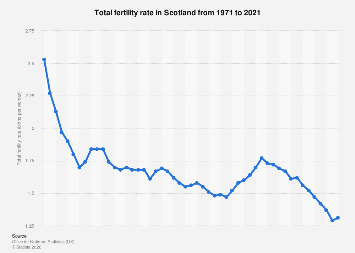
Thankfully Scotland is doing their bit:

In 2021 the total fertility rate in Scotland was 1.31, compared with 1.29 in the previous year, which was the lowest it has been in this provided time period. From 2002 onwards the total fertility rate in Scotland increased from 1.47 to a peak of 1.76 in 2008. Since 2008 the total fertility rate in Scotland has fallen rapidly, with only a slight increase occurring between 2013 and 2014.

 
I knew you were informed about this - thank, very helpful; it’s one of the big issues of our time and instead people in Cumbria worry about “the boats”

2.1 to be precise (presumably to cover for gay people, infertile people , childhood mortality etc) but yes it’s basically that simple, assuming we want to stumble along. Sustaining welfare actually requires each generation to be larger than the previous.

But sticking with 2… consider that means that every couple (not woman - it takes to two to tango) who remain childless require two immigrant families who will produce three kids each (the average i believe), and thus achieving their own replacement plus one ‘surplus’ sprog apiece to fill the gap left by our original couple. So, two families of five / ten people overall, to replace two. Except ten put more of a demand on services and infrastructure than two.

Fundamentally, glaringly, unsustainable.

From memory, the UK welfare state was predicated on a 4:1 ratio of workers to dependents (pensioners, kids, sick folk etc) and that was with people enjoying rather shorter retirements than today before snuffing it. Italy is hurtling towards 1:1 and while we are not nearly so bad, we’re getting there. It is an ex parrot of a model, whether tories or labour or the monster raving looneys are in government.

In the 90s a UN report estimated Europe would need 700m immigrants through to 2050 to sustain already underfunded welfare systems as they were at that point. Or stated another way, by that point 75% of Europeans would need to be from that immigration. I’m sure I posted this here when we see not long out of the 90s, I’ll dig out if you are interested as I have it saved.
 
I knew you were informed about this - thank, very helpful; it’s one of the big issues of our time and instead people in Cumbria worry about “the boats”
It’s not one or the other though. Or should we stop worrying about climate change and the economy also?

However, where your point has substance, is massive immigration is required because of demographic collapse. People don’t get that because the dots are never joined for them, because it’s political poison.

As I’ve noted before, and this crosses over heavily with what’s needed in response to climate change, how electable do you think a politician would be if they said to the public they need to get married, stay together, have kids, have less material things (in consequence), go less places etc.

Apart from immediately being denounced as a fascist, they’re going against people’s selfish instincts and it would be electoral suicide.
 
To view this content we will need your consent to set third party cookies.
For more detailed information, see our cookies page.


this is worth a watch, and is a suitably politically correct analysis so as not to offend any sensibilities.

This guy notes that 50% of women who reach 30 without having a child will never have one - which is way off the ratio of those who don’t want to have one. His thesis contains some pretty straightforward but plausible points such as due to career people leave it too late, not so much to try for a kid, but to find a partner with whom they will have kids.

That rings true for me, and I suspect is also the reason for many rushed partnerings and thus subsequent breakdowns.

He is less convincing when challenged on points that are less politically correct, such as demurring on the role of the pill. He counters that by citing it not being widely available in Japan when the vast post pill collapse began. But then in the next breath acknowledged they went hugely into abortion at the same time. I mean come on dude !

To my previous point about political poison, he has been hounded for trying to make these points.

Ps here’s the U.N. report I mentioned

https://www.un.org/en/development/desa/population/publications/pdf/ageing/replacement-chap4-eu.pdf

Check out ‘scenario VI’ at the top of page 91 (don’t worry this is only a few pages long - it’s presumably an excerpt). This is the modelling scenario that keeps welfare funding as it was in the 90s. To do this European population by 2050 would have had to reach 1.2 billion with 75% of its then population being, or descended from, post 1995 immigrants. 701m immigrants required to enable this.

These kind of figures underlie my unpopular assertion that either welfare goes or Europe changes fundamentally in character. Either way the people who believe a labour government, even one of a Corbynesque nature, would or could change things is sadly misled. It’s already too late, it’s a dead system walking.
 
A photo of my primary school class came up on Facebook, and I was doing some numbers. Focussing on the girls only, of which there were 16 in a 32 class roll.

We can discount the boys (because the children they fathered would be counted with the mums), so those 16 girls, 8 never went on to be mothers. That means the 8 who did would have had to produce 4 children each just for the next generation to endure.

I realise that's a simplified picture, but I don't see many families of 3, or 4 children amongst my children's friends. Borne out (see what I did there) by the Scottish Fertility rate being 1.3. It's a time bomb we're leaving our children to deal with.
 
A photo of my primary school class came up on Facebook, and I was doing some numbers. Focussing on the girls only, of which there were 16 in a 32 class roll.

We can discount the boys (because the children they fathered would be counted with the mums), so those 16 girls, 8 never went on to be mothers. That means the 8 who did would have had to produce 4 children each just for the next generation to endure.

I realise that's a simplified picture, but I don't see many families of 3, or 4 children amongst my children's friends. Borne out (see what I did there) by the Scottish Fertility rate being 1.3. It's a time bomb we're leaving our children to deal with.
Same in my circles. An interesting tidbit is that among people who do have children, the picture is not dissimilar to what it has been historically- in terms of the distribution of family sizes. The problem is the rise in people who don't have any at all, in pursuit of career or materialism, because they've been priced out by the former, or simply because there was no chair for them when the music stopped.

There is a big class element to this: University educated women are far less likely to have sprogs. This is partially due to careerism, no doubt partly to do with ingesting wacky doctrines, and partly to do with women being snobs, as study after study finds.

Where doctors used to marry nurses, bosses married secretaries, pilots married hostesses etc, career women are not given to 'marrying down'. This means there are not enough suitable men for them to go after and many miss out. The more fortunate ones meanwhile, exacerbate wealth polarisation through 'assortative mating' as money (or earning potential) marries money. But pushing half the population to uni is the main motor of this, by far.
 
Although in their case, things have been exacerbated by emigration, the Greeks are introducing a six day working week to cope with population shortfalls as well as being skint. Specifically it’s a 48 hour work week, with five longer days as an alternative.

40% pay uplift for 20% more hours, so it doesn’t make sense economically, but I guess that’s what happens if you can’t hire extra workers. It’s elective of course, but if workers who do it have 40% more cash than those who don’t, the latter may end up priced out if they don’t join in.

That emigration problem, meanwhile, is just a European example of talent stripping of poorer countries, which we rely upon.


I'm sure Trinity Decor have a system where you can work 4 days with 10 hour shifts and you get the Friday off.

Or you can also work the Friday if you choose for extra shekels.
 
I'm sure Trinity Decor have a system where you can work 4 days with 10 hour shifts and you get the Friday off.

Or you can also work the Friday if you choose for extra shekels.
That’s still a forty hour week though by the sounds ?

These hours dinnae seem that long to me, having been mug enough to work in IT, though that is for sure very different to physical work when it comes to enduring long hours.

I reckon I’ve average 50 hours a week over 30 plus years (paid for 35 obvs). Cannae be far off anyway. Thank feck the bounce was there for much of it to get me through 🤣

On a more serious note, that’s partly a consequence of it being one of the first non manufacturing roles where offshoring has run rampage. One day it will come to public sector offices too.
 
Aye it's still 40 hours although the private sector Decorators used to do a 37 hour week while building companies done 38 hours.

Saying that it was yonks ago when I worked with Miller Construction.

I would think the extra 3 hours would have a bit of an enhancement wage wise.

But in the private sector large decorating companies don't really exist anymore. Self employed and agencies put paid to that.

But I think office workers should work until they are 76 and workers in the building trade should retire at 66. 😒
 
Aye it's still 40 hours although the private sector Decorators used to do a 37 hour week while building companies done 38 hours.

Saying that it was yonks ago when I worked with Miller Construction.

I would think the extra 3 hours would have a bit of an enhancement wage wise.

But in the private sector large decorating companies don't really exist anymore. Self employed and agencies put paid to that.

But I think office workers should work until they are 76 and workers in the building trade should retire at 66. 😒
It is quite obviously the case people doing physical work cannot keep doing it in the same way, which seems barely to register with white collar politicians talking about later retirement.

The latter might be economically essential, but a better answer has to be found than suggesting that an aging spark trains up to be a computer programmer or something. Firstly, these roles aren’t for everyone, and secondly, if they’re not offshored they’re about to be wiped by AI.

As someone who has spent 30 odd years constantly ‘learning new skills’ that can’t go on indefinitely either. There’s no way your brain can keep doing that at 50+ the way it can in your 20s or 30s.

Quite the pickle.
 
Yep building trade workers bodies are knackered by the mid 50's.

When we all meet up now it's all talk about our ailments and who's nearly deid.

But hey we can retrain like you've said and become IT experts. That's what a geezer said at a jobs fair one day.

If you can use a mobile phone you could use a computer we were told. Aye right then.
 
In the 1990s the Scottish Prison Service had a huge remuneration revamp. (I worked with them not for them.)

Part of that was officers were offered the choice working a 40 or 48 hour week.

I suppose it depends where you are in life as to how long you're prepared to work for how much money.

In another role I worked 6 days a week to keep my family going. It was with mixed emotions. The money was good but I missed a lot of the kids growing up.
 
I’m lying in bed thinking about this.

Say the population of Scotland is 5M, half men, half women.

To sustain the population at similar levels in the next generation, is it as simple as every woman needs to bear 2 children? Or it it a bit more complicated than that?

Probably need to factor in the women who don’t live to see child bearing age. Increasing life expectancy, maybe.
I’ve done my bit… twice.
 
Couple of things

Anxiety re replacement rate implies we need a growing or stable population, not necessarily the case, as noted above global population levels combined with consumption are unsustainable.

Welfare affordability based on 4:1 worker to non worker model to get affordable. Not sure what it is now but either we extend period of life where the average person works and or increase productivity of workers? Need efficiency in service provision too, for me we should define rights as part of a constitution and manage economy to deliver that for everyone
 
Couple of things

Anxiety re replacement rate implies we need a growing or stable population, not necessarily the case, as noted above global population levels combined with consumption are unsustainable.

Welfare affordability based on 4:1 worker to non worker model to get affordable. Not sure what it is now but either we extend period of life where the average person works and or increase productivity of workers? Need efficiency in service provision too, for me we should define rights as part of a constitution and manage economy to deliver that for everyone
Well no we don't need it, unless of course we want that welfare. And the existence of welfare creates the problem because people no longer need kids to look after them, when other people's will do so.

Your solutions are interesting as they resemble a kind of neo liberal view of the world - which ought not to be the case given your declared starting point but these days is not surprising.

Yes people can work harder and longer to compensate for the fact that we didn't reproduce ourselves, but is this what we want? It seems to me a bit muddled that the answer is to slog longer and harder and to be no better off for it, to avoid reproduction.

It works well for those at the top of the pile I guess, but a strange place for a socialist thinker to end up; workers chained for longer to the wheel through alienation from the forces of reproduction. But these are indeed among the tensions that have seen political thinking get further and further away from labour interests.

I'm going to point out re the last part my well worn complaint; bits of paper don't do anything. How we would achieve those aims is the challenge. To be blunt we can't satisfy everything I think you would like us to. We have fundamentally contradictory demands.

However if we are to have a constitutional starting point it needs to begin from responsibilities. A disconnection between rights and the responsibilities that underpin them and allow them to be, is a big part of the problem.
 
I’ve done my bit… twice.
Which imho should entitle you to a pension that makes a distinction between you and those who did not. You have after all contributed the workers that will pay for your pension and theirs, and borne most of the cost of doing so.

Won't happen though because that would hit the wrong people, ie the city boys and gals that parties serve.
 
Blimey!

Had twins both times?
That's some record Bill.
I once knew of a couple who decided to go for a third child to see if they could get the girl or boy (cannae mind) they wanted.

They had twins. Then the missus of the couple pretty much immediately got pregnant again in unplanned pregnancy; triplets.

Two to seven in 24 months. That's gotta hurt :coffee1:
 
Blimey!

Had twins both times?
That's some record Bill.
All singles plus an extra 1, so it was twice and a half really. My auldest laddie has twins though.
A mate from my teens was a twin, as was his 2 older by 2 years brothers. And 2 older brothers than them as well.
Some hand me doons in his hoose.
 
Well no we don't need it, unless of course we want that welfare. And the existence of welfare creates the problem because people no longer need kids to look after them, when other people's will do so.

Your solutions are interesting as they resemble a kind of neo liberal view of the world - which ought not to be the case given your declared starting point but these days is not surprising.

Yes people can work harder and longer to compensate for the fact that we didn't reproduce ourselves, but is this what we want? It seems to me a bit muddled that the answer is to slog longer and harder and to be no better off for it, to avoid reproduction.

It works well for those at the top of the pile I guess, but a strange place for a socialist thinker to end up; workers chained for longer to the wheel through alienation from the forces of reproduction. But these are indeed among the tensions that have seen political thinking get further and further away from labour interests.

I'm going to point out re the last part my well worn complaint; bits of paper don't do anything. How we would achieve those aims is the challenge. To be blunt we can't satisfy everything I think you would like us to. We have fundamentally contradictory demands.

However if we are to have a constitutional starting point it needs to begin from responsibilities. A disconnection between rights and the responsibilities that underpin them and allow them to be, is a big part of the problem.
I should clarify these aren't my solutions I'm spitballing potential solutions to kickstart a debate. I don't find the doom forecasting useful unless it precipitates a solution. If we can't do anything about it why worry, if we can great. I think the problem is health, social care and welfare is unaffordable (in widest sense cash AND other resources). One REASON is demographics but reversing that isn't really an option (is it?) so M what woul you do?

I agree re rights and responsibilities being intrinsically linked 👍
 
I should clarify these aren't my solutions I'm spitballing potential solutions to kickstart a debate. I don't find the doom forecasting useful unless it precipitates a solution. If we can't do anything about it why worry, if we can great. I think the problem is health, social care and welfare is unaffordable (in widest sense cash AND other resources). One REASON is demographics but reversing that isn't really an option (is it?) so M what woul you do?

I agree re rights and responsibilities being intrinsically linked 👍
He would bring back christianity. :giggley:
 
I should clarify these aren't my solutions I'm spitballing potential solutions to kickstart a debate. I don't find the doom forecasting useful unless it precipitates a solution. If we can't do anything about it why worry, if we can great. I think the problem is health, social care and welfare is unaffordable (in widest sense cash AND other resources). One REASON is demographics but reversing that isn't really an option (is it?) so M what woul you do?

I agree re rights and responsibilities being intrinsically linked

I’m sure you don’t find it useful. I take the view that like climate change, people can’t possibly grapple with what it entails until they are aware of the gravity of the situation.

As I’ve said before, I’m not sure that there is much that can be done under democracy as we know it, and within the social order as we have it. EG’s solution while offered as jibe probably would help massively, but that’s beyond the reach of politicians.

So what could they do?

Well let’s look at what needs to happen to right the ship;

1 - we need to stop growing lifestyle related demand on services
2 - we need to grow supply into services, both funding and labour
3 - we need to try to create an economy that can produce decent jobs and survive in a globalised world and to lower the cost of housing
4 - we need to recognise the way the world is going and prepare for it; namely we can’t continue to behave as if in lala land safer under America’s paternal protection.

None of these lead to easily (if at all) sellable political positions.

Individuals need to reassume a great deal more responsibility for the collective, which means getting and staying together, having kids, not making demands on services that arise from freely chosen courses rather than the fickle hand of fate in terms of sickness or whatever.

A connection needs to be reestablished between putting in and getting out. A sense of collectivism needs to be rekindled to inspire the sacrifices needed. We can’t ignore cultural faultlines so that has to inform migration policy in a discriminatory way.

We need to move away from our wealth generating class being ‘anywheres’, loyal to nothing but their bank account and ready to skip off where the grass is greener.

Unless we want standards of living to fall to meet those rising in the developing world, we need to lower production costs without simply decimating wages. We need to encourage people to pay more for western / British produced goods and services.

We need to do all this while rearming and steeling ourselves for a turbulent century.

So absent a grass roots motivator like Christianity, or secular / national identity and traditions, how do you do it? Especially as a well fed elite will exercise their democratic freedoms to message directly in the opposite direction. Not easily.

Policy positions that could be considered might include:

- vastly raising taxes for those who do not have children (with exceptions for the infertile, gay people, clergy, those in roles devoted to the service of others such as healthcare etc). I’m talking a target figure of something like 10k to 20k per year, but then banded as normal to reflect income. Two tier pensions as well. That’s how massive it would need to be I think, so not sellable.

- speaking of pensions, compulsory investment in your own pension in the order of 10-15% of earnings.

- incentivise stable relationships, so massively tax second properties and otherwise disincentivise house price pumping. Immigration needs slashed for similar reasons. Risk the ire of pearl clutchers by rethinking housing for homeless youngsters, along the lines of student accommodation, with personal rooms but shared facilities. Provide life training services on site and make mandatory. Rearchitect the NHS - maintain free at the point of use principle, federate and variegate supply model. None of this is sellable.

- Also tax incentives for marriage both direct and via employers - return of the married man’s allowance although ‘person’ these days. State takes all assets of those who die without children to inherit, adjusted to 50% if they give to nieces or nephews, adjusted to 100% if donated to charities or institutions working on social care in the UK. Conversely, relax inheritance tax when bequeathed to kids - up to a limit i’d need to get my calculator out for. Perhaps just about sellable but very difficult with all arms of the establishment with their guns turned on it.

- frack, frack, frack. Increase the VAT paid on offshore services and levy a tax on intra company use of offshore services to discourage moving jobs overseas. Find a way to tax globalised retail models based on the location of the buyer. Very hard sell.

- revise our education approach to encourage values that support the above. Introduce Scandinavian or Swiss style national services vs whatever half baked pish Rishi was wibbling about. First bit easily sellable to the public, but will prompt a revolt in the educational establishment. Second part not sellable.

- ban under 18s from social media. We have enough problems raising our kids without Chinese and Russian intelligence lending a hand.

Just off the top of my head there. Sound authoritarian to you? It sure does to me. That’s the problem once a society stops doing these things organically- they require authoritarianism to impose. Which is exactly why radicals encourage license to the maximum extent they can, so they can step into the carnage and impose a total system.

You might wish for solutions, but they might not be possible while maintaining all the contradictory things you would like to preserve or support. That where we are I think. When I was greeting about this 20 years ago maybe there was still time but I doubt it. It’s too late now to reverse course within our existing premises I fear. And when you add in the pressure of climate issues that are diametrically opposed to improving jobs etc in their implication, well, democracy in an atomised society held together with sticky tape, is going to really struggle. The door is open for the far left or right, with cheap promises of easy fixes. I can’t see it being easily closed.

Edit - and the above could easily bankrupt us too, especially as the money markets would not exactly be sympathetic.
 
Last edited:
It is quite obviously the case people doing physical work cannot keep doing it in the same way, which seems barely to register with white collar politicians talking about later retirement.

The latter might be economically essential, but a better answer has to be found than suggesting that an aging spark trains up to be a computer programmer or something. Firstly, these roles aren’t for everyone, and secondly, if they’re not offshored they’re about to be wiped by AI.

As someone who has spent 30 odd years constantly ‘learning new skills’ that can’t go on indefinitely either. There’s no way your brain can keep doing that at 50+ the way it can in your 20s or 30s.

Quite the pickle.
So many layers of problems with ‘making people work older’. My line of work, caring for those with dementia, is very hard physical work. Traditionally this is done by women for the usual ridiculous reasons. Many of the staff over age 50 in this line of work are struggling with the physical nature of the work and there’s no way they can keep doing it to age 70 or whatever. So who is gonna do it as the aging population needing care increases but the pool of workers willing to do the work remains the same or reduces?
 
I would say training of our youngsters to go I to the care sector and also pay a decent wage for the work done.

The care sector is very fluid and not suited to just folk passing through till something else comes along that's better paid.
 
So many layers of problems with ‘making people work older’. My line of work, caring for those with dementia, is very hard physical work. Traditionally this is done by women for the usual ridiculous reasons. Many of the staff over age 50 in this line of work are struggling with the physical nature of the work and there’s no way they can keep doing it to age 70 or whatever. So who is gonna do it as the aging population needing care increases but the pool of workers willing to do the work remains the same or reduces?
Exactly. And there will be more and more old folk with no children to play a part in their support, so you have another amplifying effect there. It all starts to compound I suspect, much like the climate feedback loops
 
On the plus side, a lot of good medicinal advances in neurology and oncology, hopefully we can head off or alleviate more people now and in near to middle future.

Genetics too - despite all the moral challenges to be faced - offers more and more opportunities to reduce the amount of sufferers born with various genetically preventable conditions, or to cure those for whom prevention is too late.
 
I would say training of our youngsters to go I to the care sector and also pay a decent wage for the work done.

The care sector is very fluid and not suited to just folk passing through till something else comes along that's better paid.
My daughter works in the care sector and in fact asked if she could work in the secure wing in her first job. I honestly don’t know how she did it - she came home having been punched, kicked, bitten, spat on and had hot tea thrown over her. All for minimum wage but she never complained. These people should be paid handsomely for their work and not treated like skivvies.
 
Exactly. And be allowed a couple of days off if the stress of the job gets too much.

Loads of carers are there just because it's a wage.

I have nothing but admiration for folk who go into the care sector because they want to help folk.
 
Exactly. And be allowed a couple of days off if the stress of the job gets too much.

Loads of carers are there just because it's a wage.

I have nothing but admiration for folk who go into the care sector because they want to help folk.
Nowadays many Care Homes, in our area at least, are only open to self-funding clients as that’s obviously where the profits are, but are these profits being passed on to staff?